A strong hardscaping website should help a prospective customer answer five questions quickly: does this company build the kind of outdoor space I want, can I trust the quality of its work, does it understand the site conditions behind a lasting installation, what may influence the investment, and how do I take the next step? The best hardscaping website design examples combine inspiring project photography with clear services, useful planning guidance, credible construction proof, and a simple path to request an estimate.
The ten examples below show how residential and commercial hardscaping companies can organize their websites around real customer decisions—from comparing patios, retaining walls, walkways, and outdoor living features to reviewing materials, seeing a design preview, understanding drainage and base preparation, and starting a qualified project conversation.
Hardscaping website design examples: quick overview
- Transformation-first hero: Show the difference a well-designed hardscape can make with one focused message and clear next steps.
- Visual service selector: Help visitors choose patios, pavers, walls, walkways, steps, kitchens, fire features, or commercial work.
- Guided estimate experience: Collect the project type, approximate size, material direction, timing, budget range, and photos without overwhelming the visitor.
- Project case studies: Organize real work by project type and explain scope, materials, site conditions, and design decisions.
- Design visualization: Help customers understand the proposed layout, features, and materials before construction begins.
- Material education: Compare natural stone, concrete pavers, porcelain, and retaining-wall systems using practical selection criteria.
- Technical credibility: Explain drainage, grading, excavation, base preparation, reinforcement, and installation standards in plain language.
- Outdoor-living planning: Connect patios, kitchens, fire features, seating walls, shade, and lighting into one usable space.
- Commercial capabilities: Present experience with multifamily, hospitality, HOA, workplace, and public-facing environments.
- Bilingual customer journey: Provide complete English and Spanish paths from discovery through estimate confirmation and follow-up.
What a high-performing hardscaping website needs
Hardscaping buyers are evaluating appearance, durability, drainage, materials, timing, disruption, and investment at the same time. A high-performing website makes those decisions easier without turning the page into a technical manual. It should inspire the customer, demonstrate expertise, set realistic expectations, and collect enough information for productive follow-up.
| Website element | What it should accomplish |
|---|---|
| Clear service structure | Direct visitors to the relevant patio, paver, wall, walkway, outdoor-living, repair, or commercial service. |
| Authentic project proof | Show completed work with context about scope, materials, site conditions, goals, and location. |
| Planning guidance | Help customers understand design, materials, drainage, site preparation, timeline, and the factors that affect investment. |
| Local relevance | Connect services and material choices to the soils, weather, drainage needs, properties, and markets the company serves. |
| Qualified lead capture | Collect useful project details while keeping the estimate experience fast, mobile friendly, and easy to complete. |
| Reliable follow-up | Route inquiries into a defined process for review, consultation, site assessment, design, proposal, and scheduling. |
Beautiful project photos can earn attention, but a focused website design strategy is what connects inspiration, technical credibility, local visibility, and follow-up into one customer-acquisition system.
1. Lead with the transformation customers want
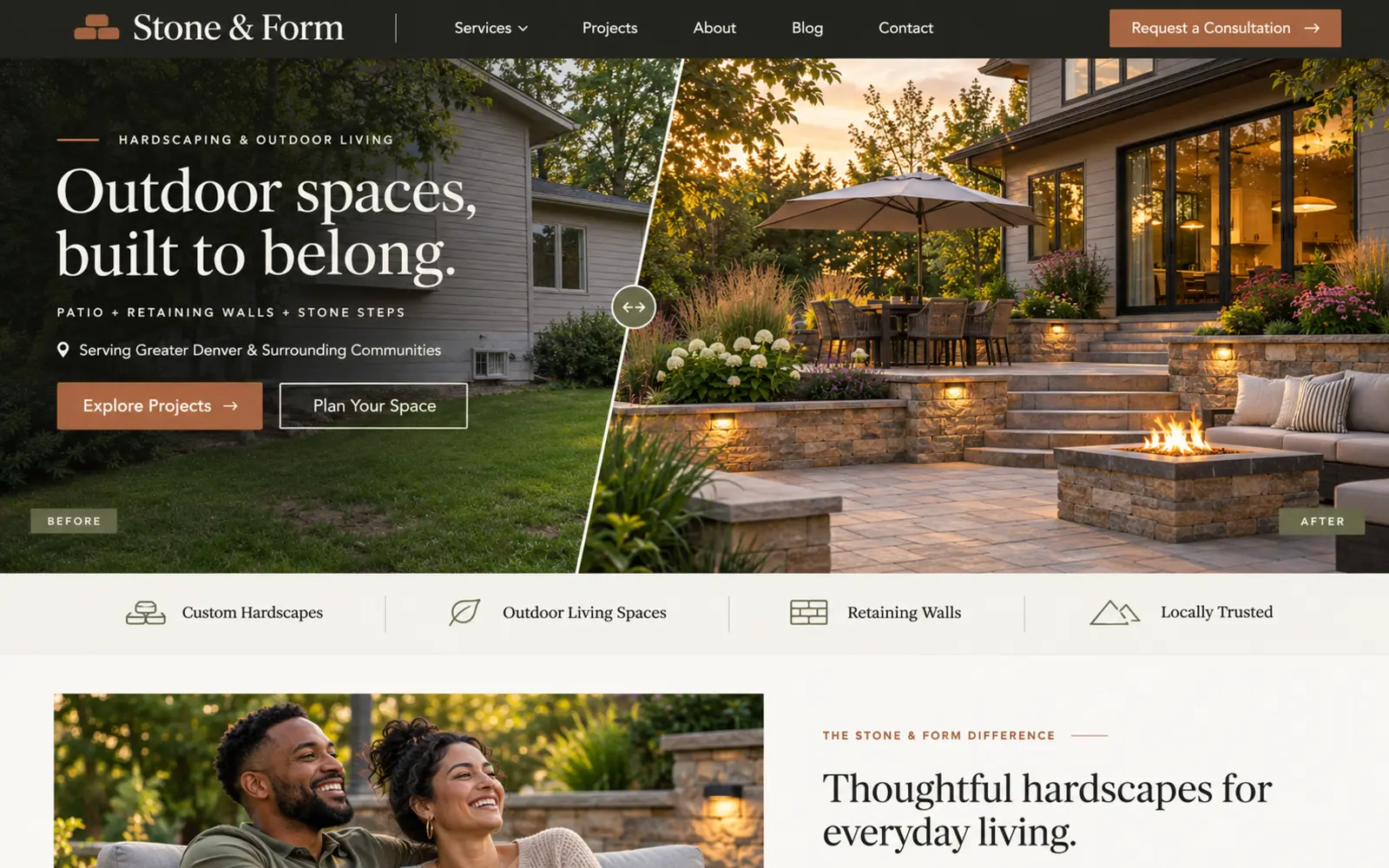
Customers rarely begin with a technical specification. They begin with an unusable yard, a cracked surface, a slope they cannot enjoy, a patio that feels too small, or an idea for a better place to gather. This design opens with a focused before-and-after transformation, one concise value proposition, a clear service area, and two next steps: explore projects or plan a space.
The comparison works because it shows the outcome without hiding the construction logic. Supporting labels can identify the patio, retaining wall, steps, lighting, drainage improvements, or planting integration that made the finished space functional. A short proof strip beneath the hero can reinforce years of experience, locally relevant materials, warranties when applicable, and a defined consultation process.
Use authentic project photography whenever the page presents completed work. Keep the message specific enough to qualify the audience, such as “custom patios, walls, and outdoor living spaces across Dallas–Fort Worth.” Compress large images carefully so the opening experience remains fast on mobile connections.
2. Let visitors choose the right hardscaping service quickly
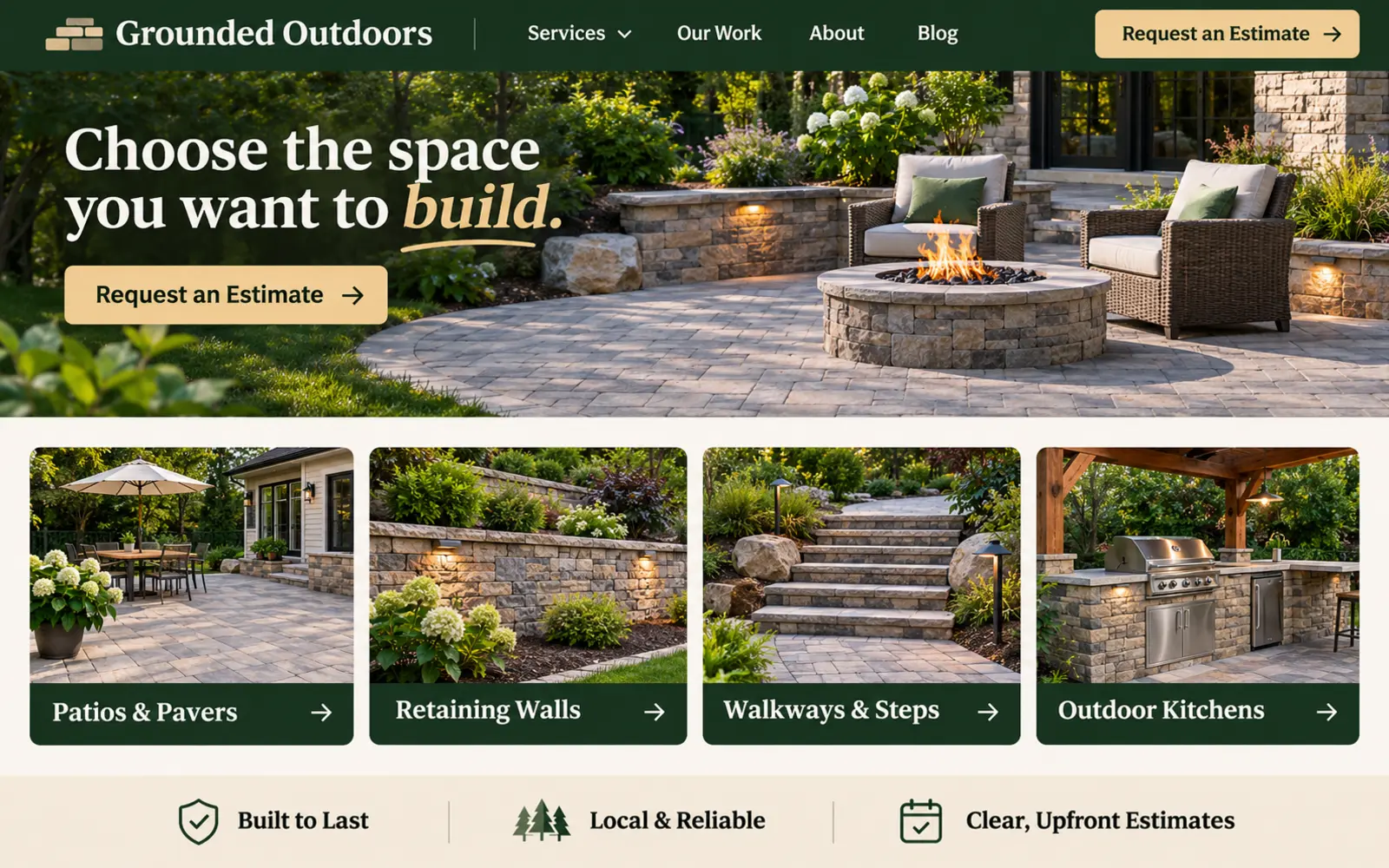
A homeowner comparing a new patio is not looking for the same information as a property manager planning a retaining wall or a family exploring a complete outdoor kitchen. This design uses large visual choices for patios and pavers, retaining walls, walkways and steps, outdoor kitchens, fire features, pool decks, and commercial hardscapes.
Each choice should lead to a dedicated page with relevant projects, material options, common planning questions, process expectations, service-area details, and the correct call to action. Avoid hiding every service inside one long generic page. Dedicated pages help visitors understand the work and give search engines a clearer picture of the company’s expertise.
Use customer language consistently. If the navigation says “retaining walls,” do not rename the same service “structural landscape solutions” elsewhere. Clear labels improve usability, advertising relevance, analytics, and sales routing.
3. Build a guided estimate experience
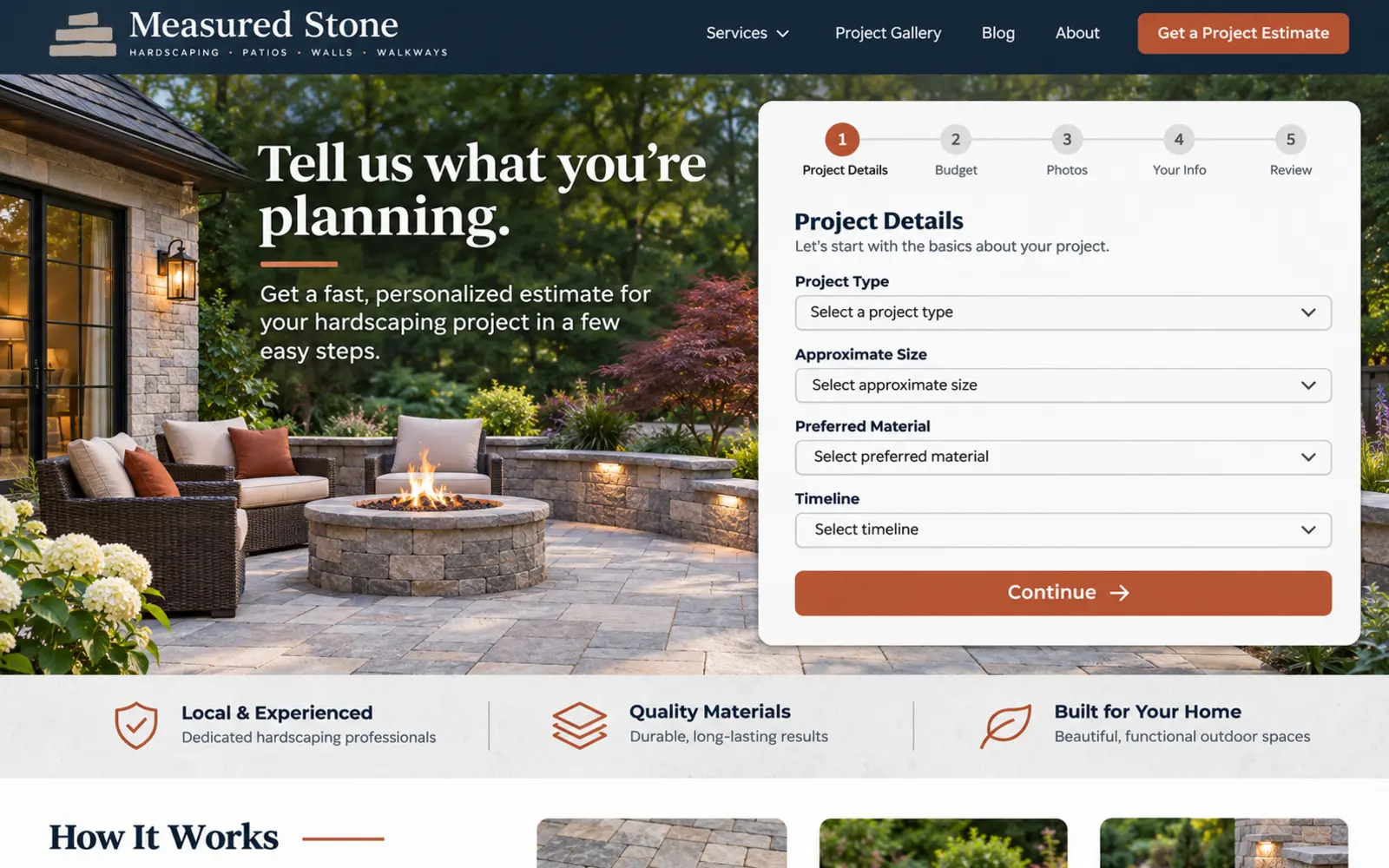
A blank contact form places too much work on the customer and too little structure around the inquiry. This design turns estimate requests into a short guided experience. The first steps ask for project type, approximate size, material direction, desired timing, broad budget range, property location, and optional photos or plans.
Keep questions understandable and allow “not sure” as an answer. A homeowner may not know the square footage, base condition, drainage requirements, or material terminology. The form should gather helpful context without asking the visitor to diagnose the site. Use conditional steps so a retaining-wall inquiry can ask different questions than an outdoor-kitchen or commercial-plaza inquiry.
Set expectations after submission. Explain when the team will review the request, whether an initial phone call comes first, when a site visit may be appropriate, and what information is needed before reliable pricing can be prepared. Connect the form to a dependable CRM and response workflow so the improved experience continues after the click.
4. Turn project galleries into useful case studies
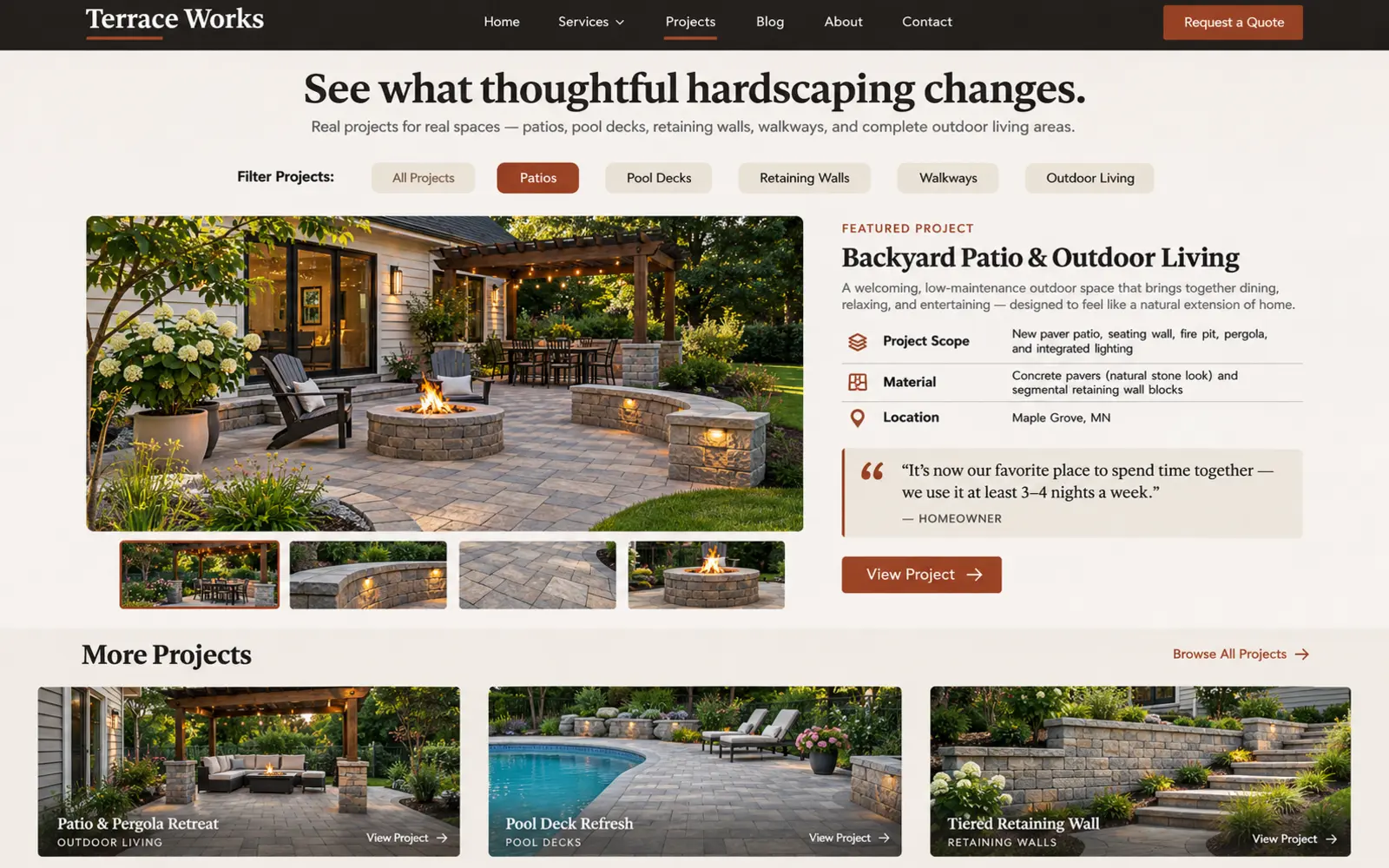
A gallery proves visual capability, but a case study helps a prospect understand whether the company has solved a similar problem. This design lets visitors filter work by patios, pool decks, retaining walls, walkways, steps, outdoor kitchens, and commercial spaces. Each project then includes multiple views and practical context.
A useful project page can explain the customer’s goal, original conditions, approximate scope, material selection, drainage or grade considerations, integrated features, location or market, and the design decisions that shaped the result. Before-and-after views, material close-ups, construction milestones, and a short homeowner quote make the proof more credible.
Do not reuse the same photographs across unrelated services or imply that inspiration imagery is completed company work. Add descriptive captions and alt text, compress files, and use responsive image sizing. A focused portfolio should make the right prospect say, “They have handled something like my project.”
5. Show the proposed design before construction begins
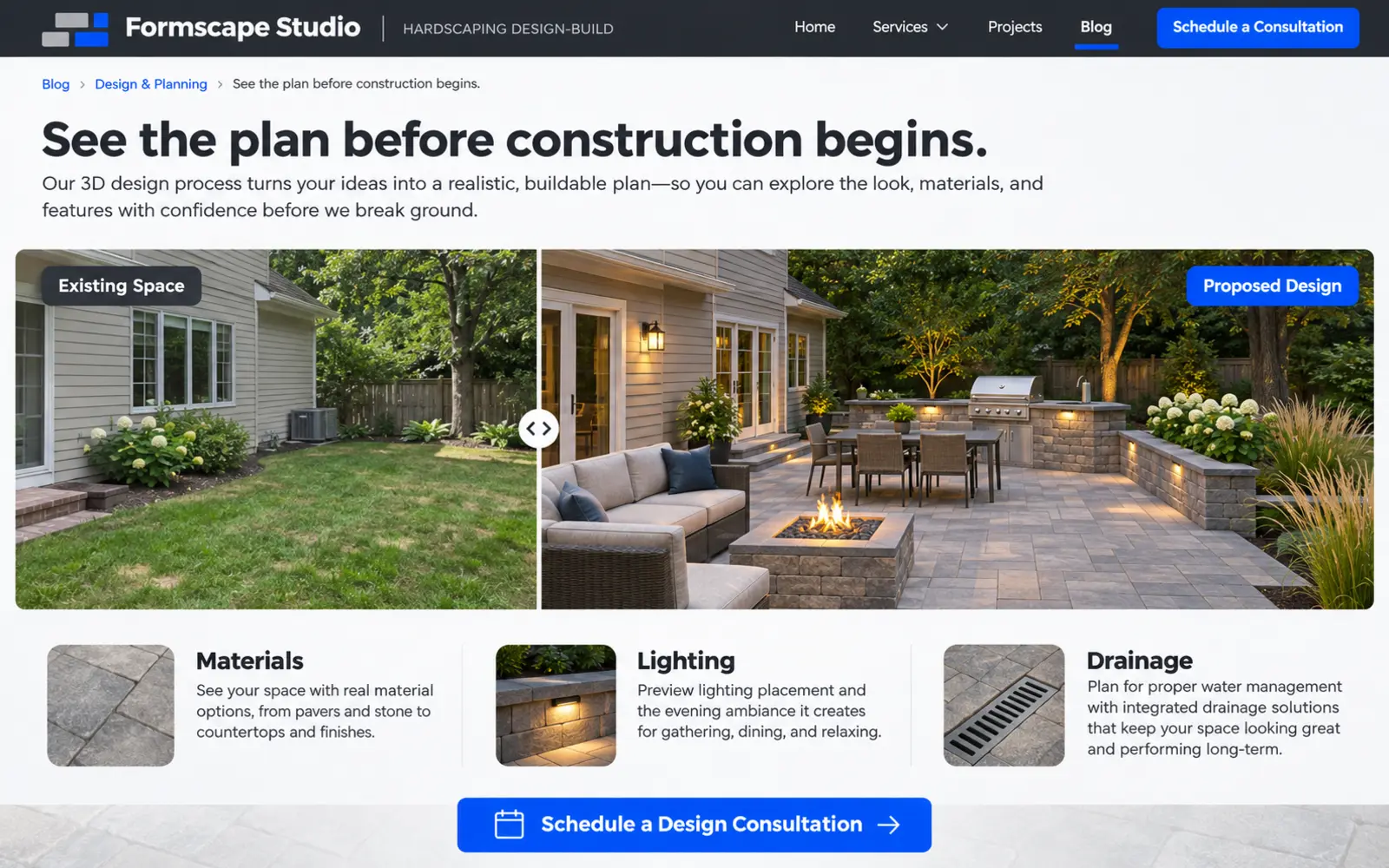
Customers can struggle to imagine how a patio, wall, kitchen, fire feature, circulation path, and lighting plan will work together. This design explains the company’s visualization process with a side-by-side existing-space photo and proposed concept, supported by clear callouts for layout, materials, drainage, elevations, and lighting.
The website does not need to promise a detailed design before a customer commits. Instead, it should explain when visualization becomes part of the process, what the customer receives, how revisions are handled, and whether design fees apply or can be credited according to company policy. Show representative examples that reflect the actual service.
Visualization is most useful when paired with practical decision-making. A beautiful rendering should connect to buildable dimensions, material availability, site conditions, budget alignment, and the installation sequence. That connection positions the company as a design-build partner rather than only an installer.
6. Educate customers about materials and price factors
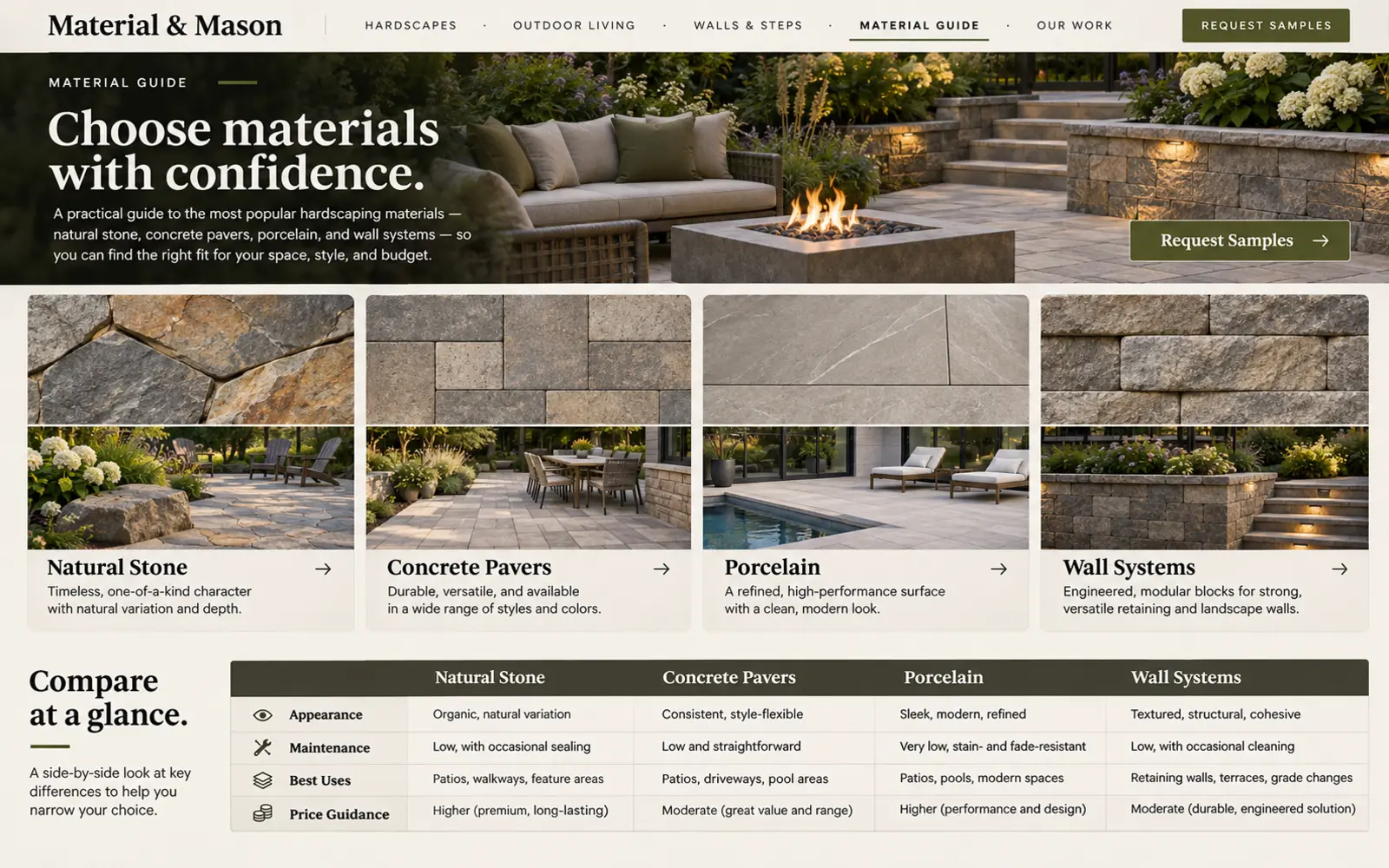
Material decisions affect appearance, surface temperature, maintenance, traction, installation requirements, availability, and investment. This design compares natural stone, concrete pavers, porcelain pavers, and segmental wall systems using large real-world examples and practical criteria rather than a wall of manufacturer language.
Each material page can explain suitable uses, visual range, maintenance considerations, common edge and border options, compatible wall or step details, and the conditions that influence installation. If the company works with specific product manufacturers, explain the selection process without making the site feel like an ecommerce catalog.
Price guidance can be useful when it is accurate and properly framed. Instead of publishing a universal per-square-foot promise, explain the factors that shape a project: access, demolition, excavation, base depth, grade, drainage, curves, cuts, walls, steps, utilities, material, finish details, and integrated features. Broad starting ranges or example scopes can help qualify inquiries when the company can keep them current.
7. Make drainage, grading, and base preparation visible
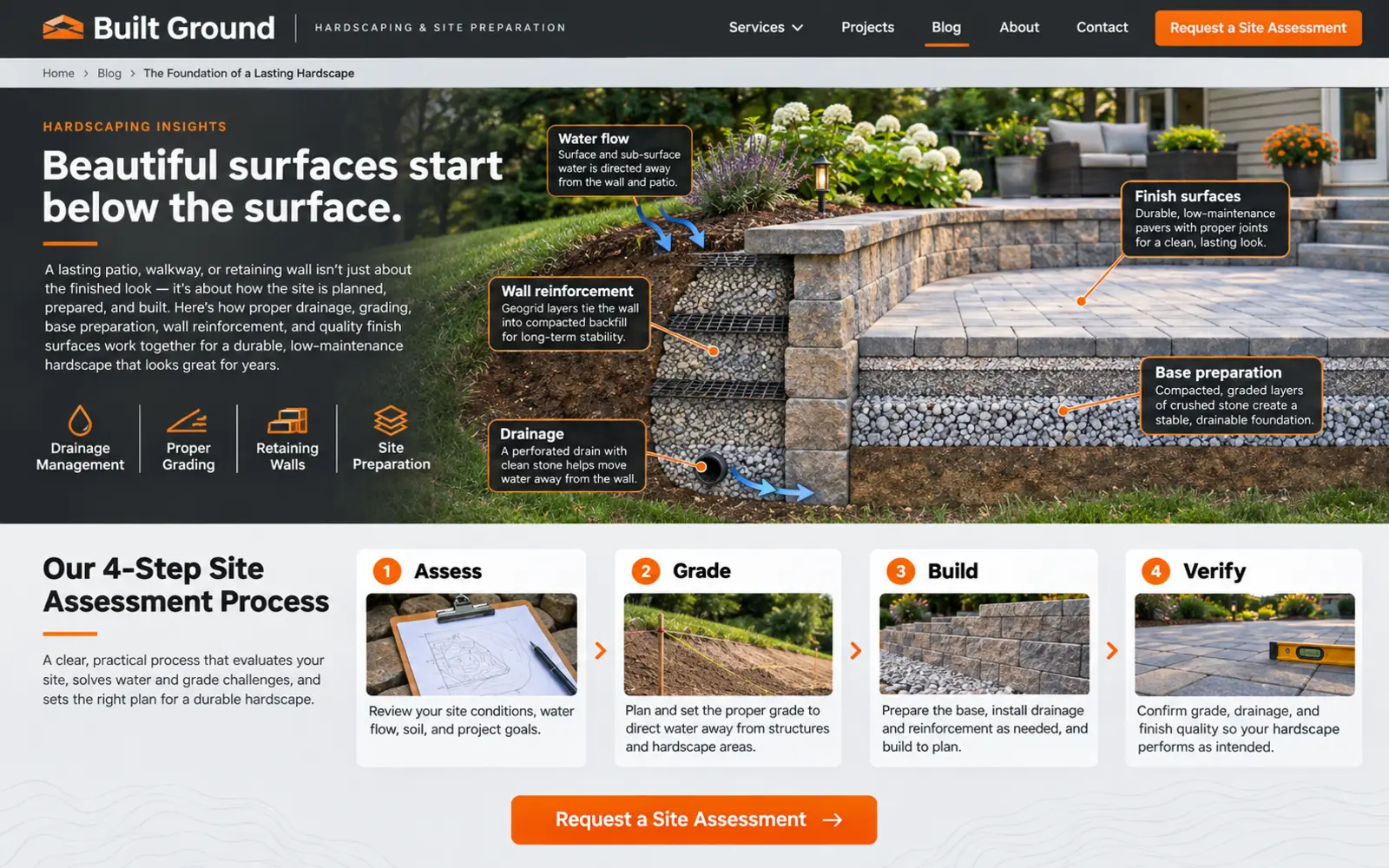
Many of the most important parts of a hardscape disappear after construction. This design uses an annotated project view and a four-step process—assess, grade, build, and verify—to explain how the company considers water movement, soil and site conditions, excavation, base preparation, wall construction, edge restraint, and finished elevations.
The goal is not to overwhelm homeowners with construction specifications. It is to demonstrate that a durable project requires more than attractive surface material. Explain what the team evaluates, which conditions may require additional planning, how drainage is coordinated, and when engineers, utility locating, permits, or other specialists may be involved.
Be precise about credentials and guarantees. Do not imply engineering services, code approval, drainage performance, or structural certification unless the company can support those claims. Credibility comes from a clear process, qualified people, documented work, and realistic expectations.
8. Package complete outdoor-living ideas without making them generic
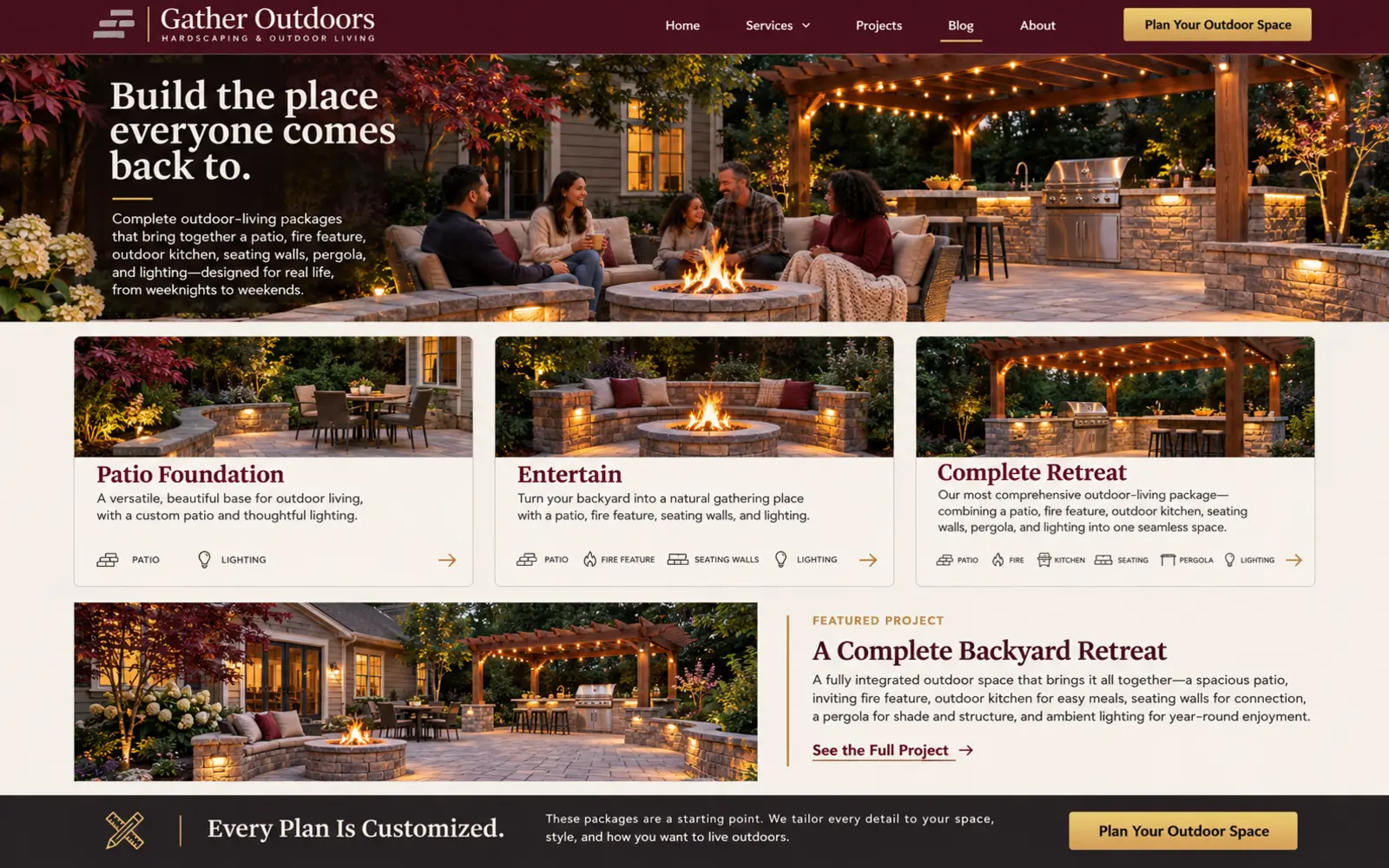
Customers often begin with one feature but need help understanding how the entire space should work. This design presents three starting points—a patio foundation, an entertaining space, and a complete outdoor retreat—while explaining that every recommendation is adapted to the property, goals, and budget.
Each path can connect paving, seating walls, steps, fire features, outdoor kitchens, shade structures, lighting, drainage, planting transitions, and access. Use diagrams or case studies to show circulation, furniture zones, cooking clearances, grade changes, and how the space connects to the home. The page should help a visitor think in systems rather than collect disconnected features.
Avoid rigid “packages” if the company does not actually sell standardized scopes. Position them as planning pathways or inspiration levels and explain what affects the final proposal. The website should make larger possibilities understandable without pressuring every customer into the most expensive option.
9. Give commercial hardscaping its own buyer journey
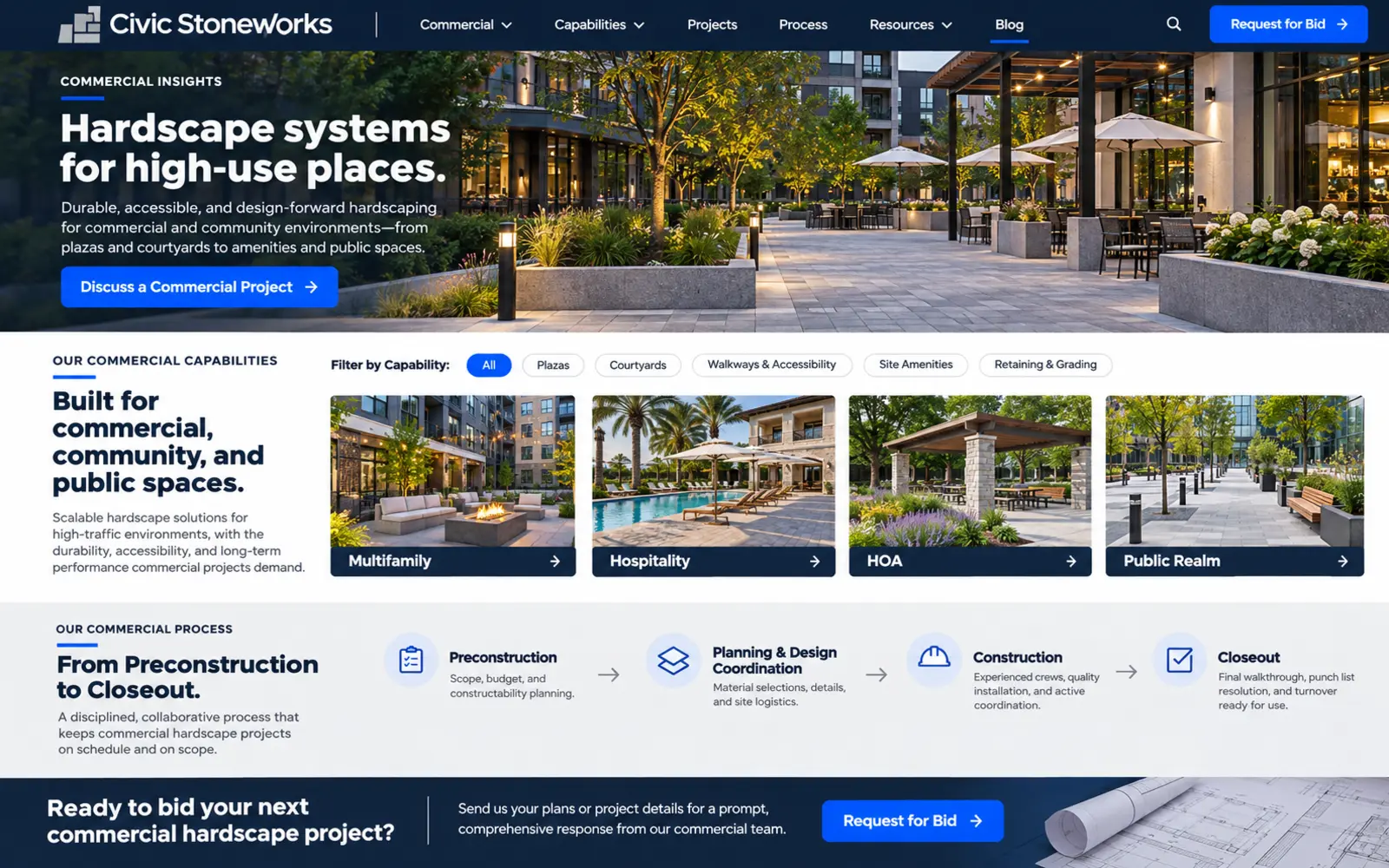
Commercial buyers evaluate capabilities, safety, scheduling, coordination, documentation, accessibility, durability, and occupied-site impact differently from residential customers. This design gives multifamily, hospitality, HOA, workplace, and public-facing environments a dedicated path rather than adding one sentence to a residential page.
Present relevant scopes such as plazas, courtyards, walkways, entries, pool decks, amenity areas, seat walls, retaining systems, repairs, and phased replacements. Project pages can explain the property type, scope, material system, access constraints, coordination, schedule considerations, and closeout process without disclosing confidential client information.
The request form should support the commercial workflow with fields for property type, location, desired scope, planning or bid stage, target timing, and document upload when appropriate. Include only verified insurance, safety, certification, bonding, or delivery claims, and give decision-makers a direct way to discuss the project.
10. Create a complete bilingual hardscaping experience
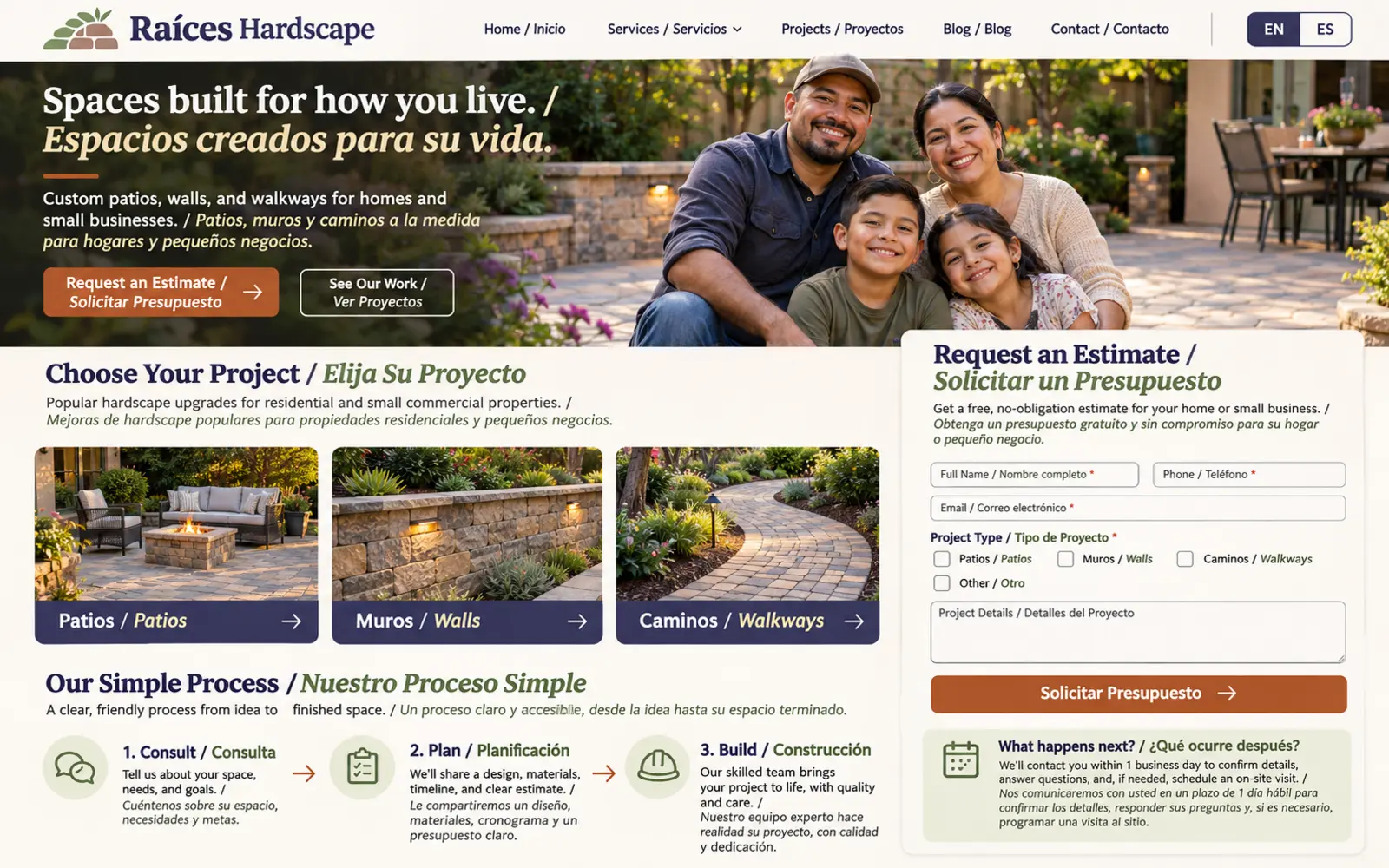
A translated headline does not create a complete bilingual customer journey. This design gives English- and Spanish-speaking visitors equal access to service information, project galleries, material guidance, the construction process, estimate forms, validation messages, confirmations, appointment details, and follow-up expectations.
Professional translation should account for regional language and construction terminology while remaining clear to homeowners and commercial buyers. Navigation, downloadable materials, automated replies, photo-upload instructions, and consultation reminders should stay consistent with the selected language.
The operational experience matters as much as the website. The company needs a dependable way to respond in the customer’s preferred language and accurately discuss scope, materials, scheduling, site conditions, and next steps. Hispanos Marketing treats bilingual communication as part of a complete multicultural customer experience—not as a decorative translation layer.
Hardscaping website design checklist
Before launching or redesigning a hardscaping website, confirm that it supports the way customers explore ideas, evaluate workmanship, compare options, and request an estimate:
- Residential, commercial, repair, and specialty services have distinct paths when offered.
- Every core service has relevant project proof, planning guidance, and a clear next step.
- Project galleries identify scope, materials, challenges, location or market, and design decisions.
- Drainage, grading, excavation, base preparation, and construction standards are explained accurately.
- Material pages help customers compare appearance, maintenance, uses, and investment factors.
- Design and visualization services are explained with realistic deliverables and expectations.
- Price guidance is framed responsibly and reviewed when labor, materials, or operating conditions change.
- Estimate forms collect useful details without requiring customers to diagnose technical conditions.
- Service-area pages contain useful local information rather than duplicated city copy.
- Pages and galleries load quickly and remain easy to use on a phone.
- English and Spanish journeys are complete when bilingual service is offered.
- Calls, forms, consultations, site visits, proposals, and qualified project sources are measured.
If the initial cost and upkeep of a traditional website are barriers, explore our managed website plans. They combine a professional website framework with hosting, routine maintenance, and technical support in one monthly plan.
Frequently asked questions about hardscaping website design
What should a hardscaping company website include?
A hardscaping website should clearly present services, project galleries, materials, process, service areas, company information, customer reviews, planning guidance, FAQs, and estimate options. Depending on the business, it may also need design visualization, commercial capabilities, financing information, maintenance guidance, warranties, document uploads, and bilingual content.
How can a hardscaping website generate more qualified leads?
It should help visitors identify the right service, see relevant project proof, understand the planning process, compare materials, and know what information is needed for an estimate. Dedicated service and location pages, strong local search visibility, fast mobile performance, focused forms, reliable tracking, and prompt follow-up work together to convert traffic into qualified project conversations.
Should hardscaping companies show prices online?
Price guidance can improve qualification when the company can keep it accurate and explain what it represents. Broad ranges, example project scopes, or starting investments are often more responsible than one universal per-square-foot number. Explain that access, demolition, excavation, base, drainage, grade, walls, steps, material, utilities, and integrated features can change the final proposal.
How should a hardscaping company present its project gallery?
Organize projects by service or customer goal and give each one meaningful context. Include multiple completed views, before-and-after images when available, scope, materials, location or market, site considerations, and a short explanation of the design. Use authentic work, label renderings or inspiration accurately, and optimize every image for speed.
How many pages does a hardscaping website need?
There is no universal number. A focused company may need core pages for services, projects, process, materials, company, service area, FAQs, and contact. A larger design-build or commercial contractor may need individual service pages, market pages, case studies, design resources, maintenance content, commercial sectors, team information, and bilingual versions. Page count should follow the customer journey and actual business capabilities.
How often should a hardscaping website be updated?
Add completed projects, current reviews, service changes, new materials, seasonal planning content, team updates, and revised price guidance as they become available. Review forms, integrations, local pages, tracking, mobile usability, accessibility, security, and page speed routinely. A website performs best when someone clearly owns its accuracy.
Build a hardscaping website around the project decision
The best hardscaping website is not simply the one with the most dramatic backyard photos. It is the one that helps the right customer recognize a relevant solution, understand the work behind a lasting installation, evaluate credible proof, and take the next step with confidence.
Hispanos Marketing designs conversion-focused websites for hardscaping companies, contractors, and professional service businesses in Dallas–Fort Worth and nationwide. We connect positioning, content, project proof, local relevance, user experience, and measurement so the website supports real growth. Explore our landscaping website design examples, concrete contractor website design examples, paving company website design examples, and construction website design examples, or review our website design service.
Book a call with Hispanos Marketing to discuss the right website structure for your hardscaping company.