An architecture firm website should help prospective clients, owners, developers, institutions, and community partners understand four things quickly: what the studio designs, whether its experience fits the project, how it approaches the work, and how to begin a productive conversation. The strongest architecture firm website design examples pair exceptional project imagery with concise positioning, a disciplined editorial grid, and clear paths into relevant sectors, services, and case studies.
The ten concepts below show how architecture practices can present expertise without turning the website into a dense credentials document. Each design uses large photography or renderings, refined typography, generous space, and purposeful interaction to support commercial, residential, civic, education, healthcare, hospitality, interiors, and planning work—according to the sectors each firm actually serves.
Architecture firm website design examples: quick overview
- Signature-project hero: Establish the studio's point of view through one exceptional project and a concise positioning statement.
- Filterable portfolio: Help visitors move from a broad body of work to the project types and sectors most relevant to them.
- Sector and expertise selector: Connect each audience with appropriate capabilities, people, projects, and insights.
- Process from vision to occupancy: Explain the stages, decisions, and collaboration behind a successful engagement.
- Design visualization: Use drawings, materials, models, and renderings to communicate how ideas are tested and developed.
- Project case studies: Present context, objectives, constraints, design response, and outcomes—not only a finished gallery.
- Sustainable performance: Connect environmental goals with verifiable strategies, targets, and results.
- Studio expertise and culture: Make leadership, project teams, disciplines, and working philosophy easy to understand.
- Awards and qualifications: Organize recognition, credentials, downloadable materials, and procurement contacts without clutter.
- Bilingual community engagement: Support inclusive public communication when the firm and project require it.
What a high-performing architecture firm website needs
Architecture is visual, but dramatic imagery alone does not explain whether a practice is right for a commission. A high-performing site connects aesthetic point of view with sector experience, project scale, technical capability, collaboration, and an appropriate next step. The interface should feel as considered as the work: restrained, responsive, accessible, and fast enough that large visuals never become a barrier.
| Website element | What it should accomplish |
|---|---|
| Clear practice positioning | State the firm's focus, geographic reach, project types, and distinguishing approach in concise language. |
| Relevant project proof | Let visitors filter work by sector, service, location, scale, status, or other meaningful criteria. |
| Sector-specific expertise | Connect each market to appropriate projects, leaders, services, research, and contact paths. |
| Transparent process | Explain how the firm moves from discovery and programming through design, documentation, delivery, and occupancy. |
| Credible case studies | Show context, constraints, design response, collaboration, and measured or observed outcomes where available. |
| Qualified inquiry path | Give project owners, partners, recruits, media, and procurement teams distinct ways to reach the right person. |
A focused website design strategy can connect project storytelling, sector expertise, search visibility, and inquiry routing into one cohesive business-development platform.
1. Lead with one signature project and a clear point of view
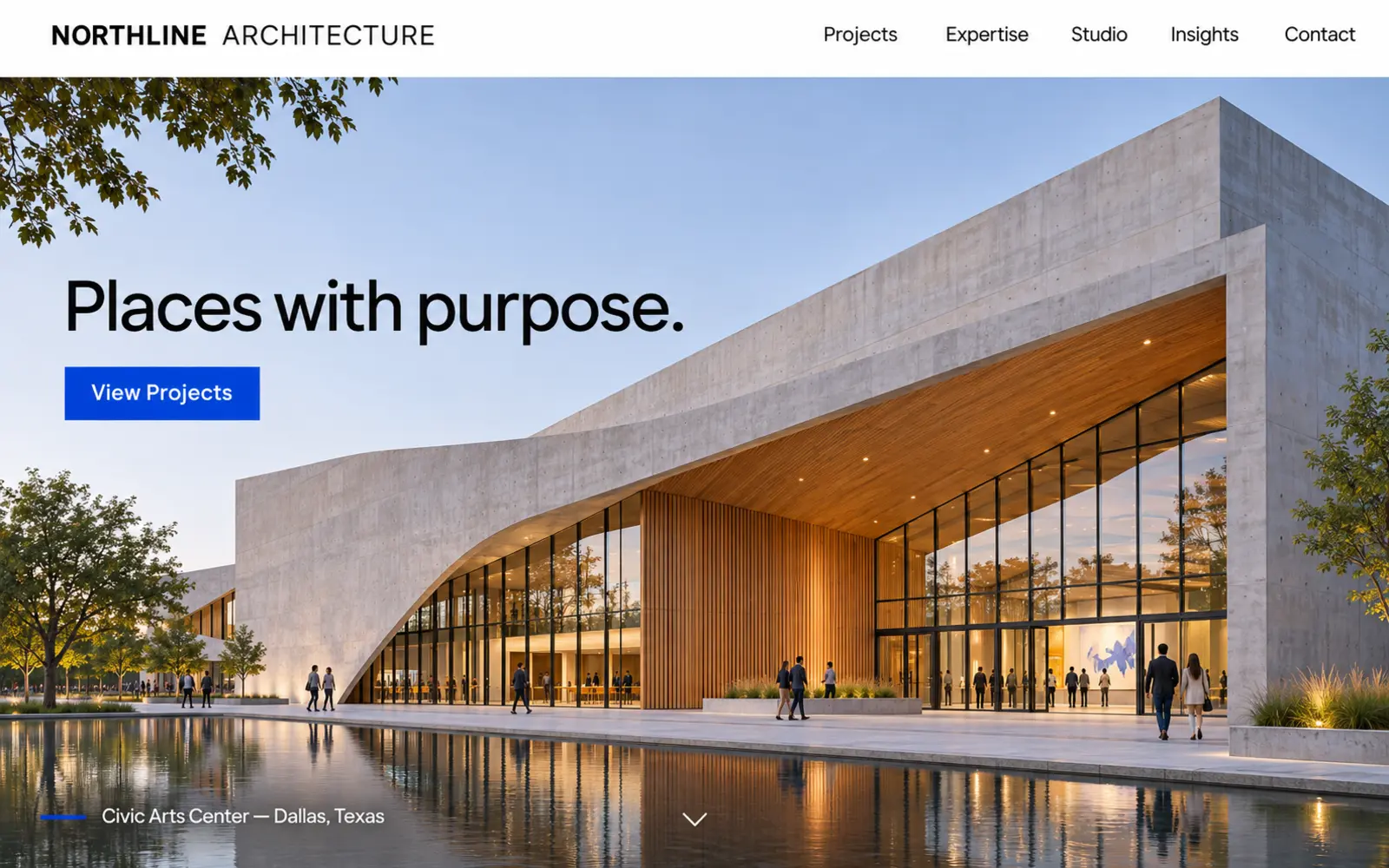
The first screen should communicate confidence before it asks the visitor to read. This concept gives one signature project most of the viewport, supported by a concise line such as “Places with purpose.” The navigation stays thin, the typography is restrained, and a single View Projects action moves the visitor into the work.
The featured image should reflect the kind of commission the firm wants to attract. A civic practice might lead with a library or cultural building; a residential studio may use a home that expresses its approach to site, light, and material. A small caption can identify the project, location, sector, and status without covering the architecture.
Rotate featured work only when each project is equally strong and accurately credited. Clearly distinguish completed photography, design visualizations, competition entries, and work performed in collaboration with other firms. The hero establishes a point of view; the portfolio provides the depth.
2. Make the portfolio filterable without making it feel mechanical
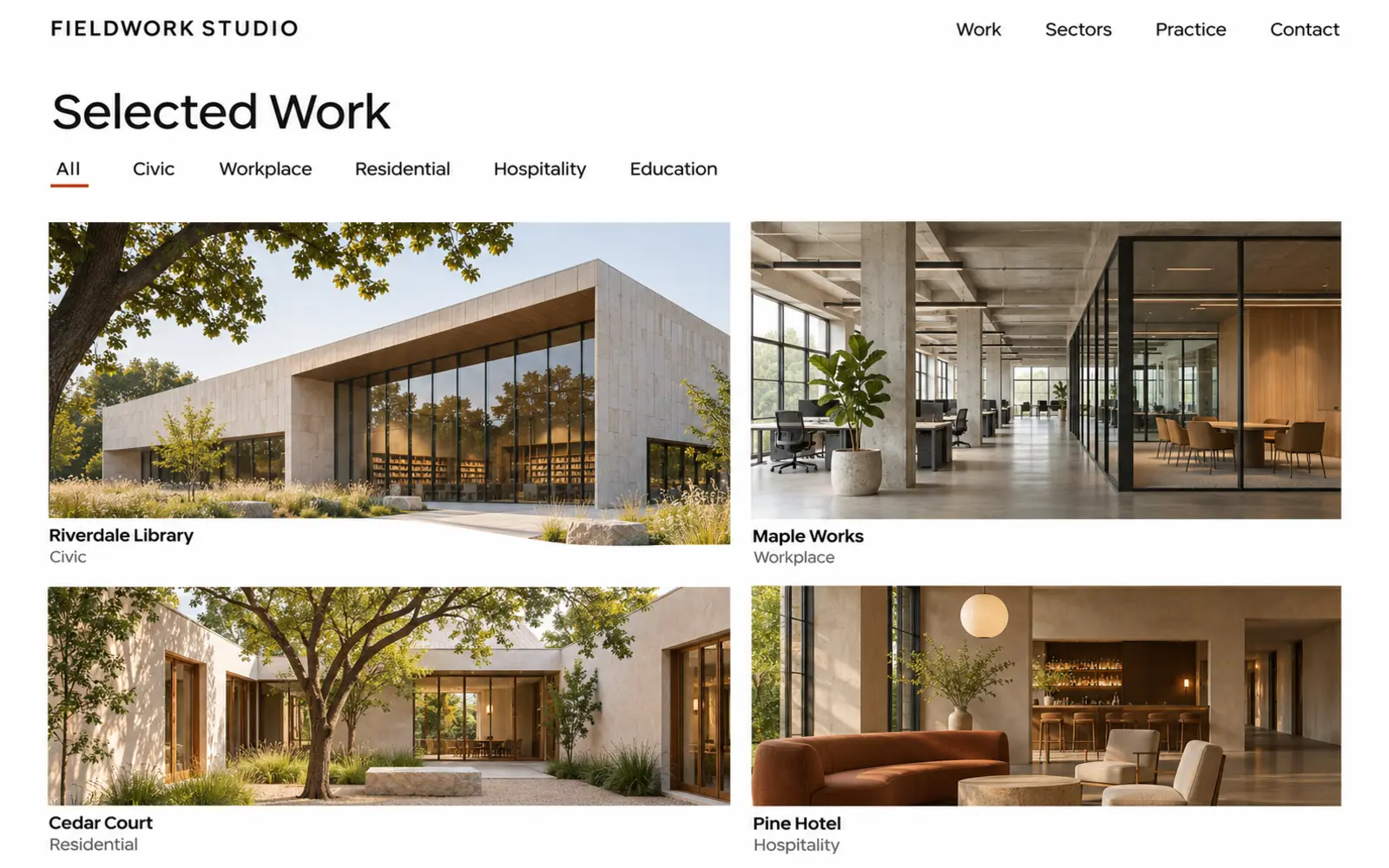
A large body of work becomes more useful when visitors can find relevant precedent quickly. This concept uses an editorial image grid with simple filters for the sectors the practice serves, such as civic, workplace, residential, hospitality, education, healthcare, or interiors. The active filter remains visible while photographs and short project captions carry the page.
Filters should reflect how clients evaluate experience, not internal filing conventions. Depending on the practice, useful options may include sector, building type, service, location, scale, delivery method, completion status, or sustainability goal. Keep the initial set limited and make every result worth opening.
Each project should lead to a focused case study rather than an oversized lightbox alone. Use consistent image ratios, descriptive alternative text, responsive loading, and carefully compressed files so an image-rich portfolio still performs well on mobile and slower connections.
3. Guide visitors by sector and expertise
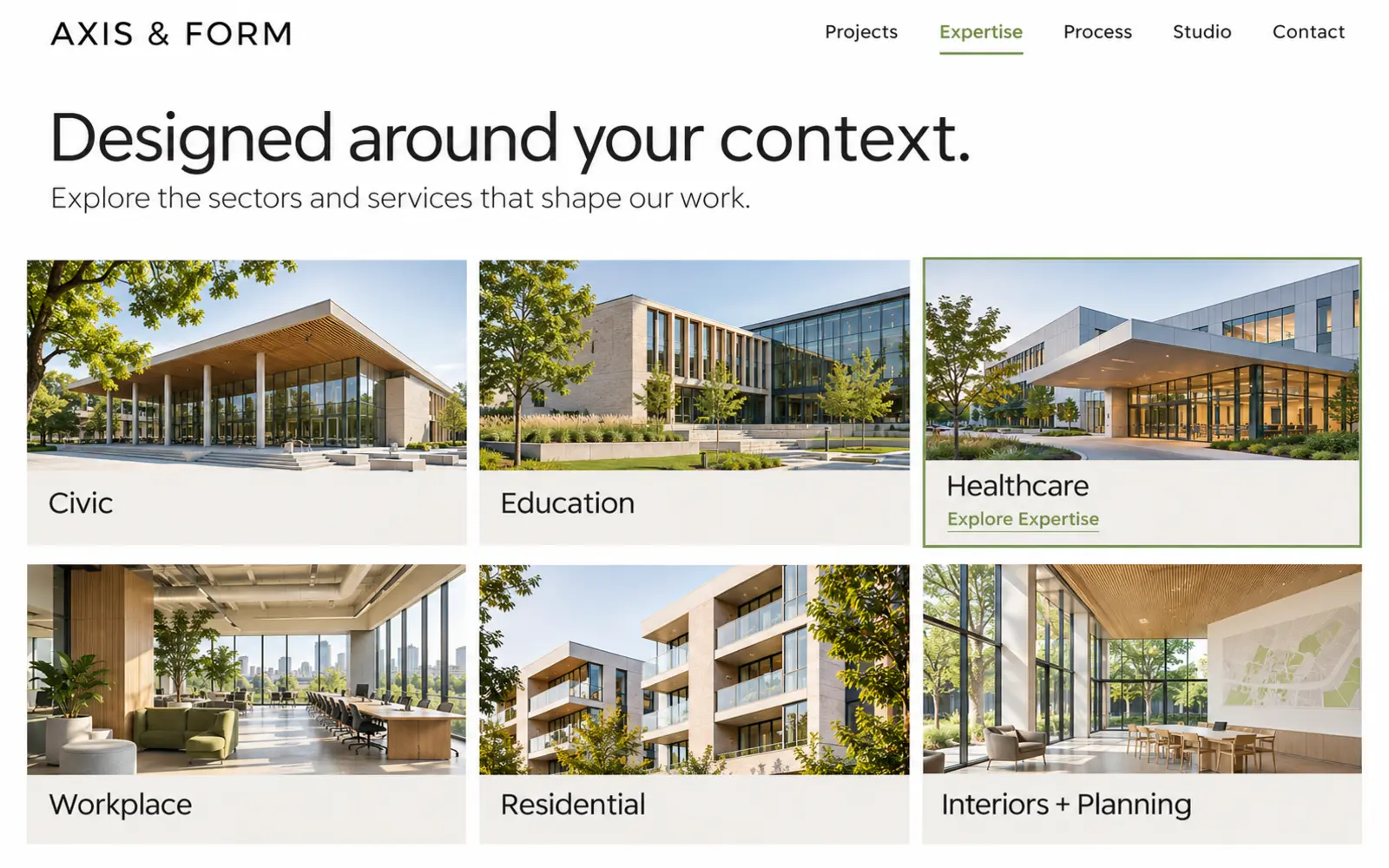
Project owners often enter an architecture website through a specific need. This concept presents large visual paths for the markets and services the firm genuinely supports. A healthcare visitor can move directly to relevant environments, leaders, planning knowledge, and case studies; a residential client can follow a different path without navigating the entire practice.
Sector pages should demonstrate understanding rather than repeat generic claims. Education content might address learning environments, campus context, phasing, and stakeholder engagement. Hospitality may emphasize guest experience, operations, brand, and interiors. Planning can connect research, community input, land use, and long-range frameworks. Include only capabilities the practice can substantiate.
Keep the selector concise and visual. Deeper pages can explain programming, architecture, interiors, planning, preservation, workplace strategy, or other real services. This separation preserves the calm homepage while giving search engines and qualified prospects useful, specific content.
4. Explain the process from vision to occupancy
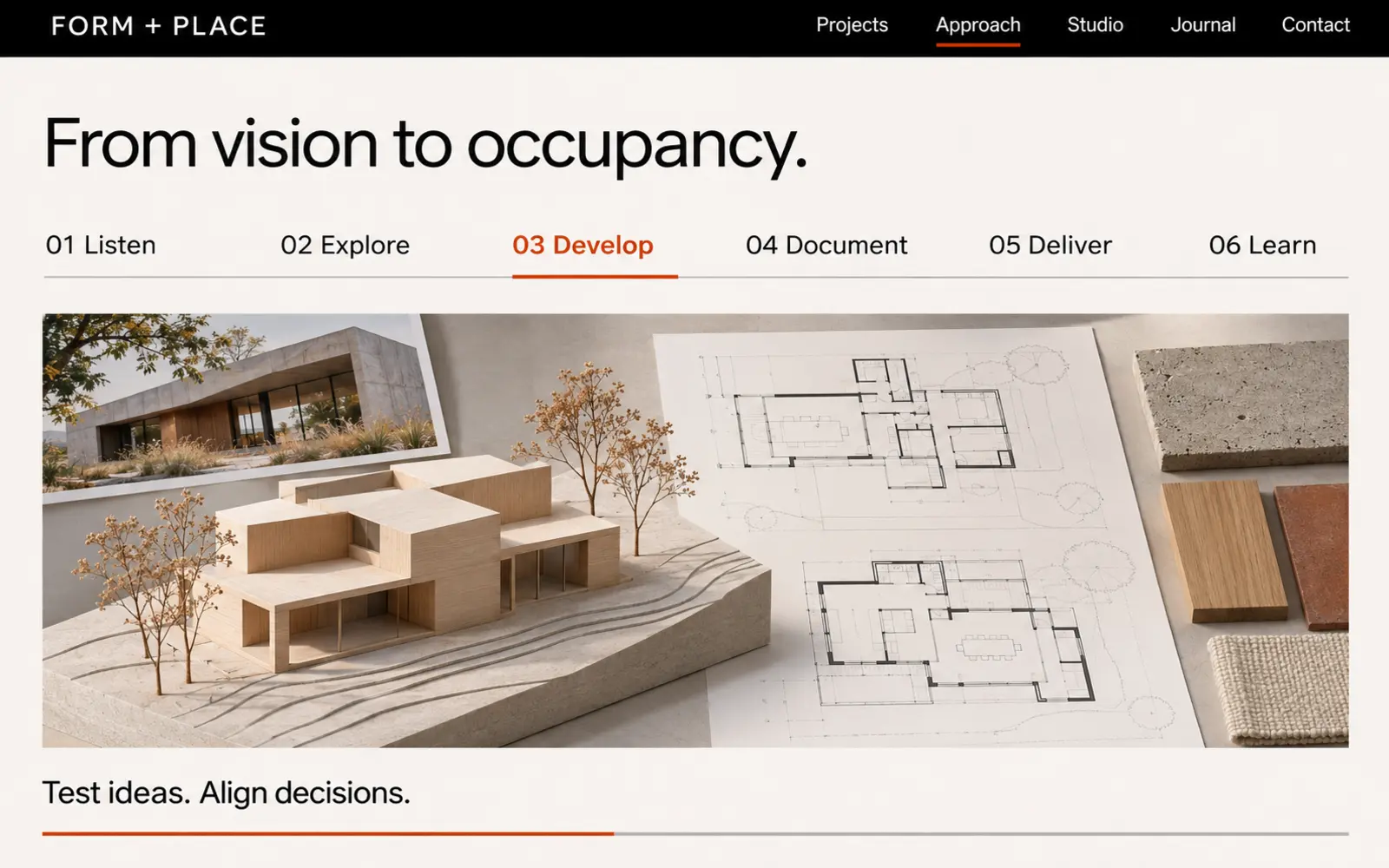
A process page should make a complex engagement feel understandable without reducing it to a rigid formula. This concept uses six concise stages—Listen, Explore, Develop, Document, Deliver, and Learn—supported by drawings, models, material studies, site observations, and completed work.
Each stage can explain the decisions being made, who participates, and what the client can expect. Early phases may include discovery, programming, research, site analysis, and concept development. Later phases may involve consultant coordination, documentation, approvals, procurement support, construction administration, commissioning, or post-occupancy learning, depending on the firm's scope.
Avoid implying that every project follows an identical path or that the architect controls approvals, construction cost, procurement, and schedule independently. The strongest process content shows how the practice creates alignment, documents decisions, and collaborates with owners, consultants, contractors, users, and community stakeholders.
5. Let visitors explore drawings, materials, and design visualization
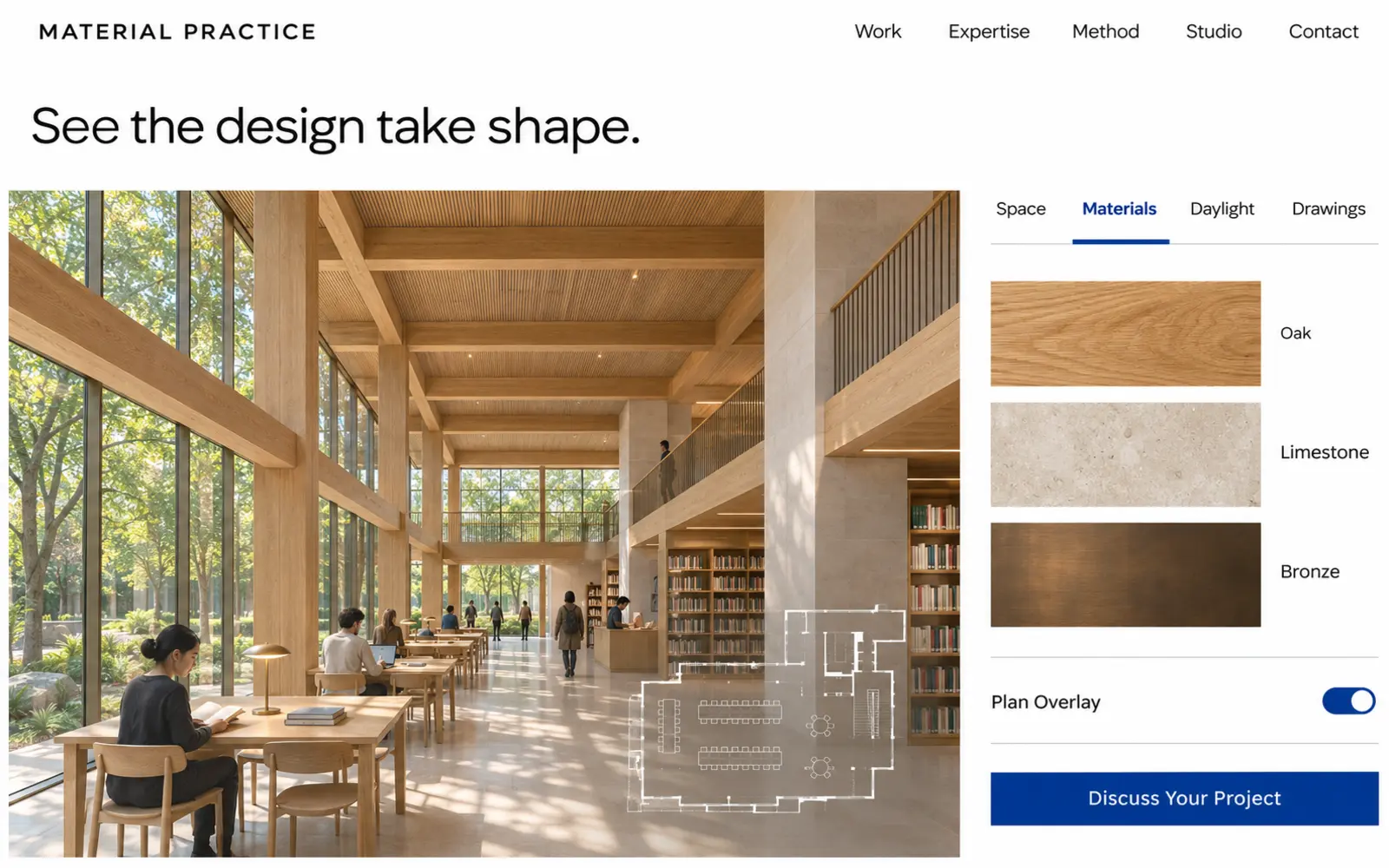
Architecture is easier to understand when visitors can see how space, material, daylight, and technical thinking relate. This concept pairs one large rendering or completed photograph with restrained controls for Space, Materials, Daylight, and Drawings. A plan overlay and a few material samples add depth without turning the interface into a software demo.
Use this interaction to explain a design decision: how a civic lobby supports wayfinding, how a school brings daylight into shared spaces, how a home responds to its site, or how an interior palette supports a hospitality experience. Models, sketches, diagrams, renderings, and prototypes can reveal the work behind the final image.
Label every visual accurately and credit collaborators. A rendering should not be presented as completed construction, and material imagery should not imply a final selection when it is conceptual. On mobile, replace complex hover behavior with simple tabs, swipes, or a clear vertical sequence.
6. Build case studies around the challenge and design response
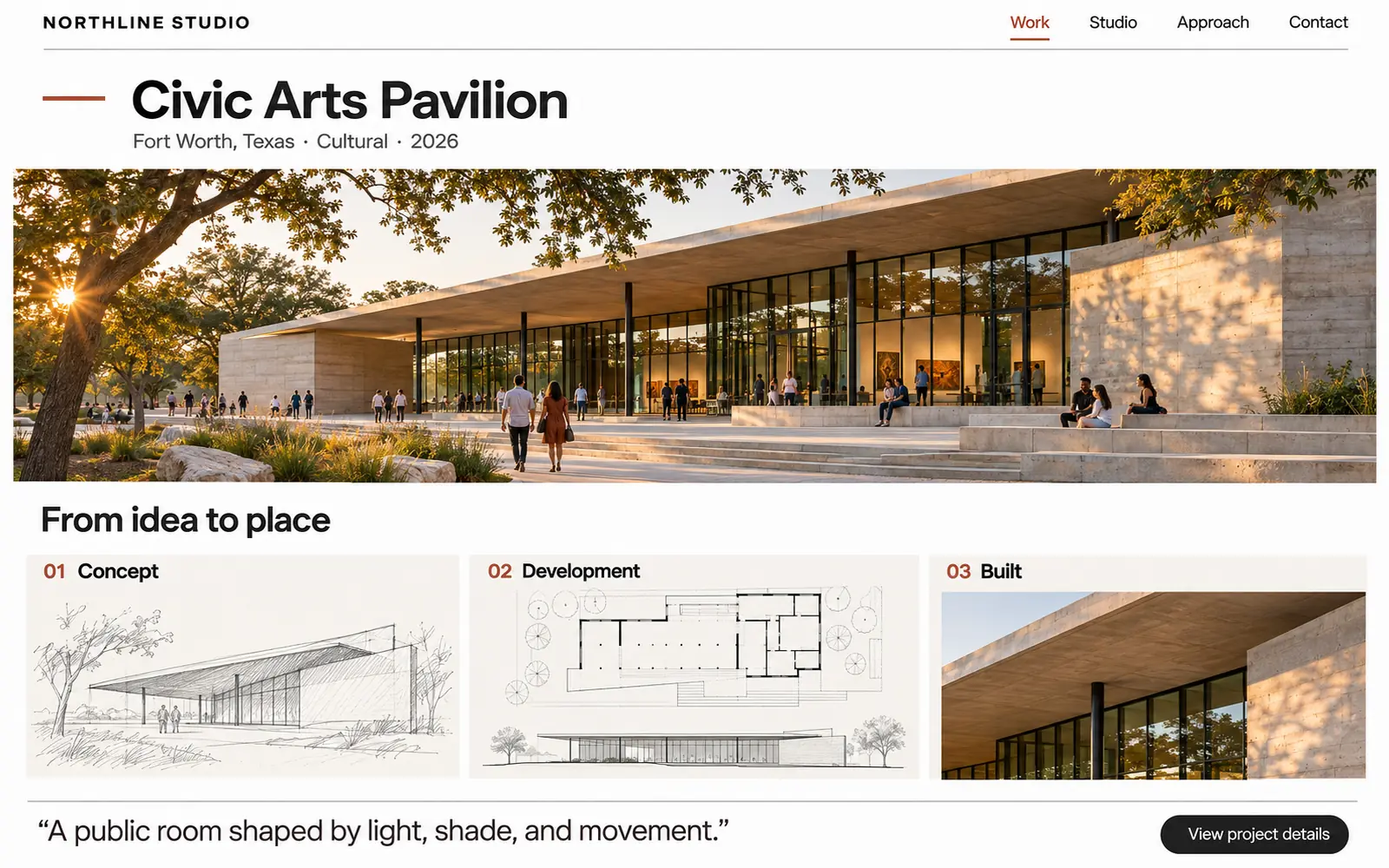
A project page becomes persuasive when it explains why the design took its form. This concept opens with a concise project summary, then moves through context, client objectives, constraints, research, key decisions, collaboration, and the resulting experience. A mix of finished photography, plans, sections, diagrams, and details supports the story.
Keep facts easy to scan: sector, location, size, status, services, client type, completion date, collaborators, and recognition where applicable. If a project is confidential or unbuilt, state that clearly and share only approved information. Outcomes can include operational improvements, stakeholder response, environmental performance, occupancy observations, or other evidence the team can verify.
Related-project links should be intentional. A healthcare case study might connect to clinical planning and other care environments; a mixed-use project may connect to planning, residential, workplace, or hospitality expertise when relevant. This turns the portfolio into a connected knowledge system.
7. Present sustainable design as performance, not decoration
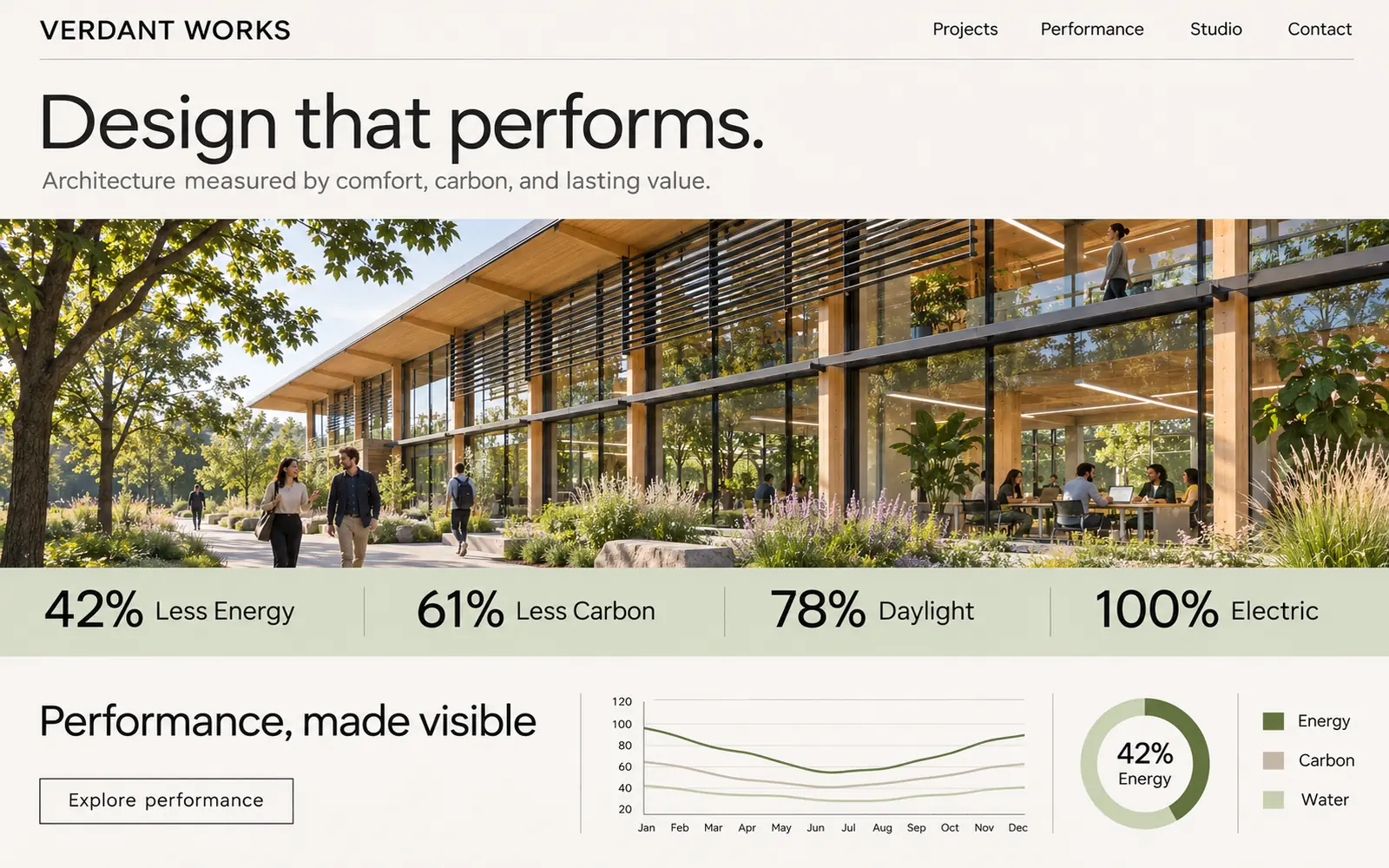
Sustainability content is strongest when it connects design intent with measurable or clearly defined strategies. This concept uses a calm performance dashboard beside project imagery to explain daylight, energy, water, materials, landscape, resilience, adaptive reuse, or occupant well-being according to the project.
Firmwide commitments and project-specific results should remain distinct. Identify whether a number is a target, model, certification, benchmark, or verified outcome, and provide the relevant boundary or source. If the firm supports recognized standards, describe its role precisely rather than treating every framework as interchangeable.
Not every visitor needs a technical report on the homepage. Use concise summaries and visual indicators, then link to detailed project data, research, or methodology. Credible specificity builds more confidence than broad language about being green or future-ready.
8. Connect studio culture with the people responsible for the work
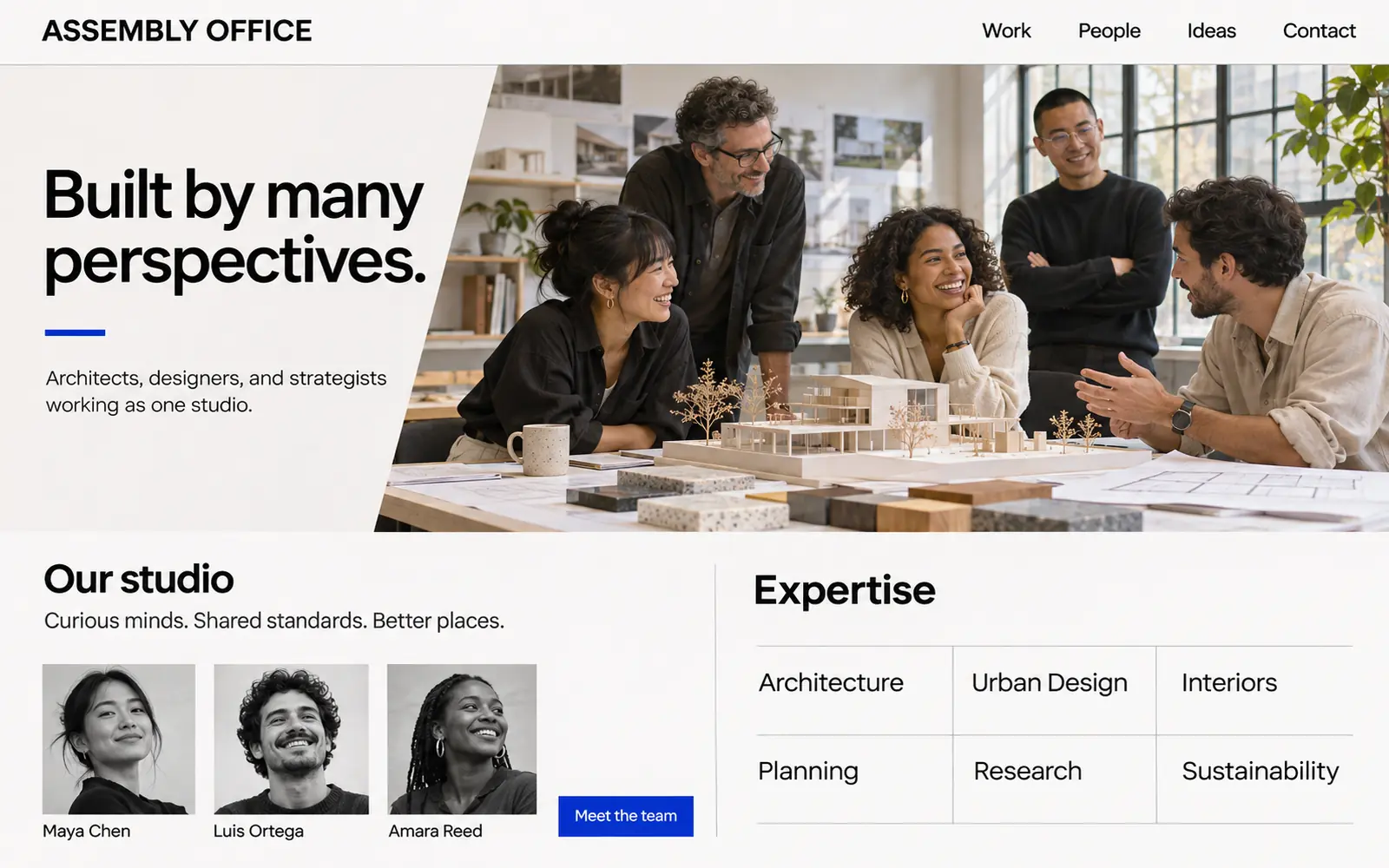
Clients hire a team, not only a portfolio. This concept combines a restrained studio introduction with leadership and project-team profiles organized by sector, discipline, location, or role. Portraits, working sessions, site visits, and model-making imagery can humanize the practice without overwhelming the work.
Profiles should help a prospective client understand relevant experience, responsibilities, credentials, and perspective. Keep biographies concise and provide consistent links to projects, articles, talks, or research. Avoid presenting every employee as an expert in every market; show how multidisciplinary teams are assembled for different commissions.
The same section can support recruiting when it accurately reflects the working environment. Explain mentorship, collaboration, professional development, office locations, and current opportunities with the same clarity used for client content.
9. Organize awards, publications, and qualifications for professional buyers
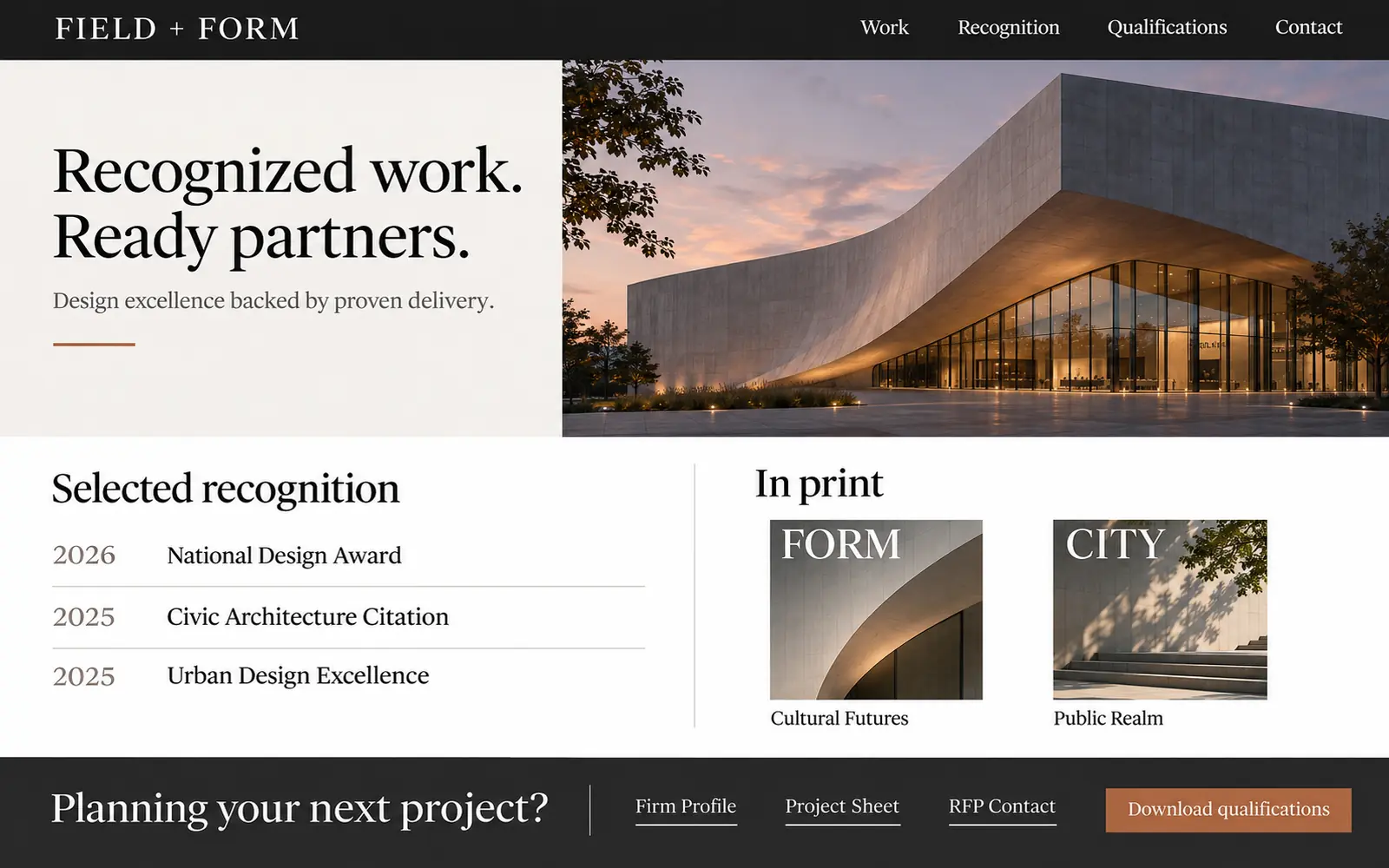
Awards and press can strengthen credibility, but long logo walls quickly become visual noise. This concept uses a clean, searchable archive with the recognition, publication, project, organization, and date. Featured items remain image-led while the full archive stays useful to clients, partners, journalists, and recruits.
Procurement teams may also need a concise firm profile, sectors, services, office locations, leadership, registrations, certifications, representative projects, and a qualifications contact. Place current downloadable materials in one clearly labeled area and include a direct path for requests for proposals or qualifications.
Publish only accurate, current credentials and distinguish firm recognition from project awards or individual honors. If insurance, registrations, certifications, or supplier-diversity status are relevant, present them carefully and provide a way to request current documentation.
10. Build a bilingual experience for community-centered work
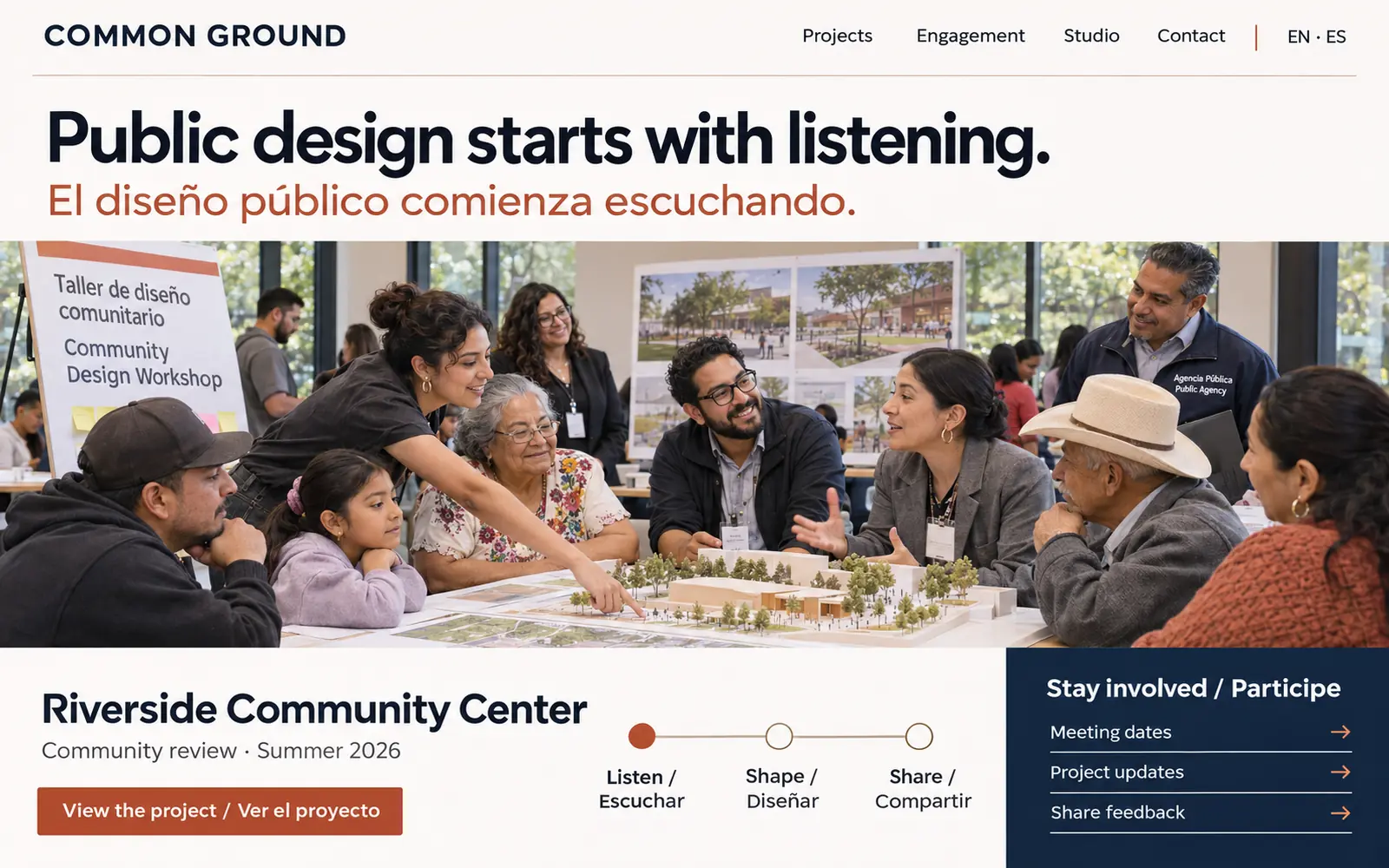
Civic, education, healthcare, planning, and community projects may involve audiences who need information in more than one language. This concept provides complete English and Spanish paths for project updates, meeting details, presentation materials, surveys, feedback forms, accessibility information, and follow-up expectations.
Translation should be professional, regionally appropriate, and coordinated with the actual engagement plan. Language access does not replace in-person outreach, trusted community partners, accessible meeting formats, or the client's public-participation requirements. It makes the digital experience more useful before and after those interactions.
For architecture firms serving the Dallas–Fort Worth region and other multicultural markets, inclusive communication can help more people understand a project's purpose and participate meaningfully. Hispanos Marketing approaches bilingual content as part of a complete multicultural user experience, not as a decorative toggle.
Architecture firm website design checklist
- The homepage communicates the firm's focus and point of view with concise language and strong project imagery.
- The portfolio can be explored by meaningful sector, service, location, scale, or project criteria.
- Sector pages connect relevant projects, people, services, insights, and inquiry paths.
- Project pages explain context, objectives, constraints, design response, collaboration, and outcomes.
- Photography, renderings, drawings, competition work, and collaborations are labeled and credited accurately.
- The process explains major stages and expectations without promising an identical path for every commission.
- Sustainability claims distinguish targets, models, certifications, and verified results.
- Leadership, team roles, registrations, awards, and qualifications are current and verifiable.
- Inquiry routing works for prospective clients, procurement teams, partners, media, recruits, and general questions.
- Large imagery remains fast, responsive, accessible, and usable on mobile devices.
- Bilingual project information is complete when multilingual communication is offered.
- Forms, calls, downloads, project views, and qualified inquiry sources are measured.
If upfront website cost and ongoing upkeep are barriers, explore our managed website plans. They combine a professional website framework with hosting, routine maintenance, and technical support in one monthly plan.
Frequently asked questions about architecture firm website design
What should an architecture firm website include?
An architecture website should clearly present the firm's focus, projects, sectors, services, process, people, locations, insights, credentials, and contact paths. Depending on the practice, it may also need research, sustainability data, publications, qualifications downloads, careers, community-engagement resources, or bilingual content.
How should an architecture portfolio be organized?
Organize work around the criteria prospective clients use to evaluate relevance. Sector, building type, service, location, scale, status, or performance goal can be useful filters. Each project should have a concise case study with accurate facts, credits, and a clear distinction between completed work and visualization.
How can an architecture firm website generate better inquiries?
Use clear positioning, focused sector pages, relevant case studies, visible geographic information, and concise calls to action. Route project opportunities, requests for qualifications, media, recruiting, and general inquiries separately, then connect each form to reliable tracking and follow-up.
Should architecture firms publish project metrics?
Useful, verifiable metrics can strengthen a case study. Publish project size, status, services, performance targets, certifications, or measured outcomes only when accurate and approved. Label modeled, targeted, and verified results distinctly and provide enough context for the number to be understood.
How many pages does an architecture firm website need?
There is no universal number. A focused studio may need projects, expertise, process, studio, insights, and contact pages. A multidisciplinary practice may need sector pages, service pages, office and leadership profiles, case studies, research, qualifications, careers, and multilingual versions.
How often should an architecture website be updated?
Update project status, imagery, awards, publications, leadership, team information, credentials, office details, and opportunities as they change. Review page speed, accessibility, mobile behavior, forms, integrations, analytics, and search performance routinely so the website reflects the current practice.
Build an architecture website that makes expertise clear
The best architecture firm website is not the one with the most projects or the most elaborate transitions. It is the one that helps the right audience recognize relevant expertise, understand the firm's approach, evaluate credible work, and begin the right conversation with confidence.
Hispanos Marketing designs conversion-focused websites for architecture, engineering, construction, and professional service firms in Dallas–Fort Worth and nationwide. Explore our construction company website examples, home builder website examples, remodeling company website examples, and concrete contractor website examples, or review our website design service.
Book a call with Hispanos Marketing to discuss the right website structure for your architecture firm.